Quick answer: To read nicotine strength on snus packaging correctly, first identify whether the number is stated in mg/g or mg per pouch. These measurements cannot be compared directly. If the label uses mg/g, multiply it by the weight of one pouch in grams to estimate the nicotine content per pouch.
Snus and nicotine pouch packaging may display values such as 12 mg/g, 8 mg/pouch, 1.6% nicotine, “Strong” or a row of strength dots. These labels can look comparable even though they do not always measure the same thing.
A common mistake is to read 16 mg/g as 16 mg in every pouch. The actual amount per pouch also depends on how much that pouch weighs. This guide explains the units, conversion formulas and label checks needed for a fair comparison.
Terminology note: “Snus” is sometimes used informally for different products placed under the lip. Traditional snus contains tobacco, while nicotine pouches contain no tobacco leaf. The mg/g and mg/pouch formats discussed below can appear on either category, so always confirm the product description.
Table of contents
- What to find on snus packaging
- What does mg/g mean?
- What do mg/pouch and mg/portion mean?
- How to calculate pouch weight from net weight
- How to convert a nicotine percentage to mg/g
- Quick guide to common nicotine labels
- Why can equal mg/pouch values feel different?
- Five common mistakes when reading snus labels
- A 30-second packaging check
- Frequently asked questions
What to find on snus packaging
Before looking at the word “Strong” or a dot scale, find these quantitative details:
- Nicotine content: the declared nicotine amount or concentration.
- Unit: mg/g, mg/pouch, mg/portion or a percentage.
- Net weight: the net weight of the product inside the can.
- Number of pouches or portions: how many individual units the can contains.
- Portion weight: the weight of one pouch, when stated directly.
- Ingredients and warnings: the formula, nicotine warning and storage information.
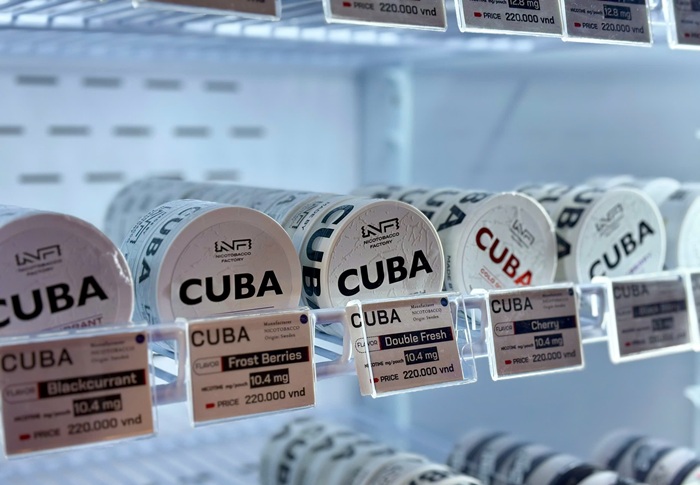
The information may appear on the base, side label, local importer sticker or manufacturer’s official product page. If the front shows a large number without a clear unit, do not assume it means milligrams per pouch.
What does mg/g mean?
mg/g means milligrams of nicotine in one gram of product. It is a concentration by weight, not the amount in each pouch.
Example: 20 mg/g means that every gram of filling contains 20 mg of nicotine according to the label.
If one pouch weighs only 0.5 g, it does not contain 20 mg. Use this calculation:
Formula:
Nicotine per pouch (mg) = Nicotine concentration (mg/g) × Pouch weight (g)
For a 20 mg/g product with 0.5 g pouches:
20 × 0.5 = 10 mg of nicotine per pouch.
This is the nominal content calculated from the label. It is not the amount that the body will necessarily absorb.
What do mg/pouch and mg/portion mean?
mg/pouch or mg/portion states the declared nicotine content in one pouch or serving. It is usually the simplest measurement for comparing two portioned products.
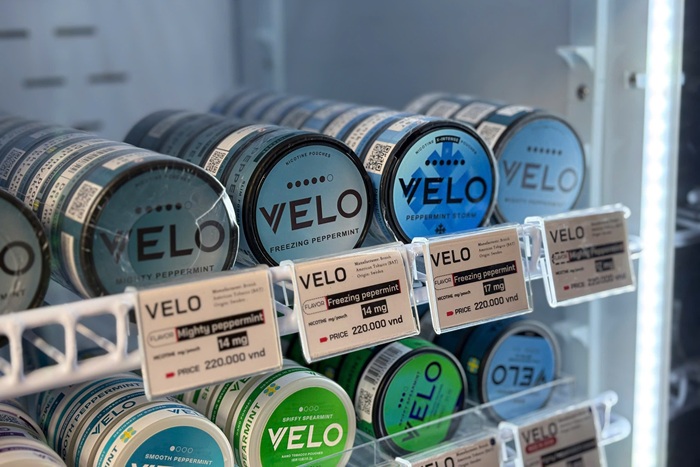
A label showing 8 mg/pouch means that one pouch contains 8 mg of nicotine according to the manufacturer. You do not multiply this number by the pouch weight to obtain the per-pouch content.
Do not directly compare 16 mg/g with 12 mg/pouch. Convert both products to the same unit first. Without knowing the pouch weight of the 16 mg/g product, there is not enough information to decide which pouch has more nominal nicotine.
How to calculate pouch weight from net weight
If the package does not state the weight of one pouch but does show net weight and pouch count, use this formula:
Formula:
Pouch weight (g) = Net weight (g) ÷ Number of pouches
Suppose a can shows:
- Net weight: 15 g;
- Quantity: 20 pouches;
- Nicotine: 16 mg/g.
Step 1: calculate the weight of one pouch.
15 ÷ 20 = 0.75 g per pouch.
Step 2: calculate nominal nicotine per pouch.
16 × 0.75 = 12 mg per pouch.
In this example, 16 mg/g works out to approximately 12 mg per pouch—not 16 mg per pouch.
How to convert a nicotine percentage to mg/g
Some labels use a nicotine percentage. When the manufacturer defines that percentage by weight, the mathematical conversion is:
Formula:
Nicotine (mg/g) = Nicotine percentage × 10
Examples:
| Label percentage | Weight-based conversion | If one pouch weighs 0.7 g |
|---|---|---|
| 0.8% | 8 mg/g | About 5.6 mg/pouch |
| 1.2% | 12 mg/g | About 8.4 mg/pouch |
| 1.6% | 16 mg/g | About 11.2 mg/pouch |
| 2.0% | 20 mg/g | About 14 mg/pouch |
This conversion only applies when the percentage represents nicotine by product weight. If the label does not define how the percentage was calculated, check the manufacturer’s official documentation rather than guessing.
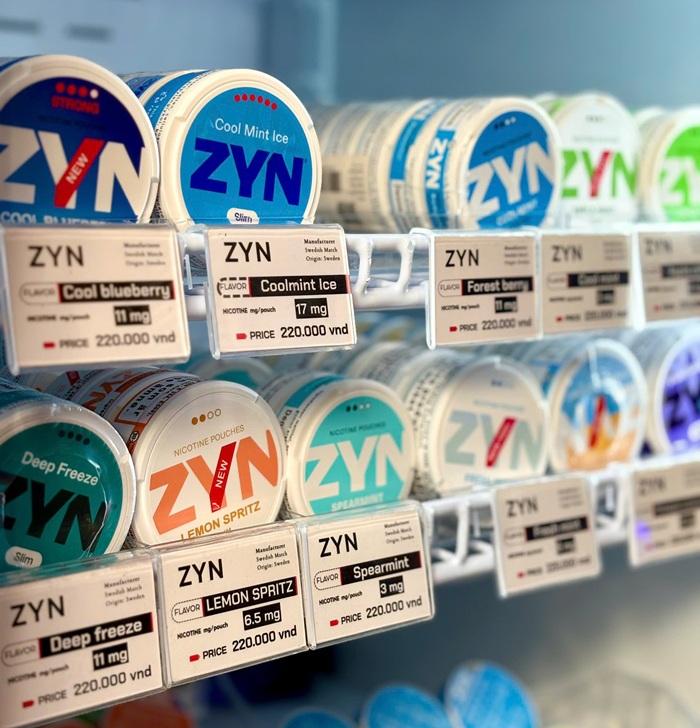
Quick guide to common nicotine labels
| Label format | What it means | Is it per pouch? |
|---|---|---|
| mg/g | Milligrams of nicotine in one gram of product. | No. Multiply by the weight of one pouch. |
| mg/pouch | Milligrams of nicotine in one pouch. | Yes. |
| mg/portion | Milligrams of nicotine in one portion. | Usually, when one portion equals one pouch. |
| Nicotine % | A percentage that requires the manufacturer’s basis of calculation. | Not directly. |
| Strong/Extra Strong | A brand’s strength category or sensory description. | Not a measurement unit. |
| Dots or bars | A brand-specific strength scale. | Not a measurement unit. |
Why can equal mg/pouch values feel different?
The number on a label describes nominal nicotine content, but it cannot fully predict release rate, absorption or a person’s experience. Differences may relate to:
- Product and saliva pH;
- Moisture level and filling structure;
- Nicotine form and the overall formula;
- Pouch size, weight and surface characteristics;
- Contact time;
- Individual nicotine tolerance.
A technical review by the UK Committee on Toxicity notes that perceived strength does not necessarily mirror total nicotine content. Release can vary with pH, moisture, flavour and other constituents. A subjective “stronger” experience is therefore not a standard measurement.
Content is not absorbed dose: A label stating 10 mg/pouch describes nominal nicotine in the pouch. It does not mean that the body absorbs all 10 mg. Do not use label arithmetic to predict blood nicotine levels or to define a “safe dose”.
Five common mistakes when reading snus labels
- Reading the number but ignoring the unit: 20 mg/g is not the same as 20 mg/pouch.
- Comparing “Strong” across brands: each manufacturer may use its own scale.
- Assuming a larger can is stronger: can size does not reveal nicotine per pouch.
- Confusing total-can nicotine with per-pouch content: read the wording attached to the number.
- Treating nicotine content as absorbed dose: these are different concepts.
A 30-second packaging check
- Confirm whether the product is tobacco-containing snus or a tobacco-leaf-free nicotine pouch.
- Find the nicotine number and read the complete unit next to it.
- If it is mg/pouch, compare it only with products also expressed per pouch.
- If it is mg/g, find pouch weight or calculate it from net weight and pouch count.
- Convert the result to mg/pouch before comparing.
- Review the ingredients, warnings, manufacturer and local rules.
Key rule: Compare values only after converting them to the same unit. Do not treat “Strong”, dots or bar ratings as a universal standard across brands.
Frequently asked questions
Does 16 mg/g mean 16 mg in each pouch?
Not necessarily. Multiply 16 mg/g by the weight of one pouch in grams. A 0.75 g pouch would contain a nominal 12 mg.
How much is 1% nicotine in mg/g?
If the percentage is defined by weight, 1% equals 10 mg/g. Confirm the manufacturer’s definition before applying the conversion.
Do strength dots show nicotine content?
No. Dots usually represent a brand-specific strength scale. They do not replace a numerical mg/g or mg/pouch declaration.
Are two 10 mg/pouch products identical?
They have the same nominal nicotine content per pouch on the label, but moisture, pH, formula, pouch design and release rate may differ.
Can the label tell me how much nicotine I will absorb?
No. Nicotine content in a pouch is not the same as the amount absorbed by the body.
Is there one nicotine level that is safe for everyone?
No single level can be described as safe for everyone. Nicotine is addictive and affects people differently. People who do not use nicotine should not start.
Sources and further reading
- UK Committee on Toxicity: technical discussion of nicotine bioavailability and product factors in oral nicotine pouches.
- JAMA Patient Page: What Are Nicotine Pouches?.
- CDC: Nicotine Pouches.
The formulas in this guide convert units printed on a label; they do not calculate the amount of nicotine absorbed by the body. This content is for general information and does not replace medical advice.
Compare products using clear label information: Explore the nicotine pouches category or learn more about Fika Pouches in Da Nang. Always check the ingredients, nicotine unit and warnings for the individual product.